
Why Does My Child Close One Eye While Reading or Watching TV?
A child may close one eye because seeing with both eyes open feels less clear or less comfortable. Closing one eye can temporarily reduce blur, glare, double vision or conflicting images when the eyes are not working together properly.
Sometimes the behaviour is occasional and harmless—for example, when bright light falls directly on the face. However, repeated eye closing during reading, television viewing, schoolwork or outdoor activity can also be associated with:
Unequal spectacle power
Short sight, long sight or astigmatism
Squint or intermittent eye drifting
Amblyopia, commonly called lazy eye
Difficulty coordinating the two eyes
Double vision
Eye strain or visual fatigue
Light sensitivity
Another eye-health problem
The behaviour alone does not tell parents which condition is present. The most useful next step is to observe when it happens, which eye is closed and whether other symptoms occur.
Children may not recognise that one eye sees differently because the clearer eye can compensate. Parents concerned about unequal vision can also read One Eye Weaker in a Child: Is It Lazy Eye?.
Why Would Closing One Eye Make Seeing Easier?
The brain normally combines the image from each eye into one coordinated view. This supports clear vision, depth perception and comfortable use of both eyes.
If the two images differ substantially in clarity or alignment, using both eyes together may become uncomfortable. A child may instinctively close or cover one eye to remove one of the competing images.
This may make the visual task feel easier even though the underlying reason remains untreated.
Closing one eye therefore does not automatically mean that the closed eye is lazy or weaker. A child may close:
The eye that sees less clearly
The eye that turns or drifts
The better-seeing eye in some circumstances
Either eye, depending on fatigue, distance or lighting
Parents should avoid deciding which eye is weaker based only on observation.
Does the Timing of the Behaviour Matter?
Yes. The activity during which the child closes one eye can offer useful clues for the eye examination.
While reading or doing close work
Closing one eye during reading may indicate difficulty keeping the eyes aligned at near distance, unequal image clarity, visual fatigue or double vision.
Other behaviours may include:
Losing place while reading
Using a finger to follow words
Bringing the page very close
Tilting or turning the head
Avoiding prolonged reading
Complaining of headache or eye strain
Rubbing the eyes
Reading more slowly than expected
These signs are not specific to one diagnosis. Reading difficulty can have visual and non-visual causes, so an eye examination should not be used as the sole assessment of academic performance.
While watching television
Television usually requires distance vision. Closing one eye while watching may be associated with blurred distance vision, an intermittent outward eye turn or difficulty coordinating both eyes.
Observe whether the child also:
Moves unusually close to the television
Turns the face to one side
Watches from a particular angle
Squints or narrows the eyelids
Closes the same eye repeatedly
Reports that the image is blurred or doubled
A child who sits close to the television does not automatically have myopia, but persistent distance-vision difficulty justifies assessment. The Child Myopia Control guide explains increasing spectacle power and blurred distance vision in greater detail.
In bright sunlight
Children with intermittent outward drifting of one eye may sometimes squint or close one eye in bright sunlight. The exact reason is not always clear, but blocking one image may make vision feel more comfortable in glare.
This pattern should be distinguished from simply narrowing both eyes because the light is bright.
When tired, daydreaming or unwell
An intermittent squint may become more noticeable when a child is tired, daydreaming or visually inattentive. The eyes may look straight at other times.
Parents can take a clear photograph or short video when the behaviour occurs, provided this does not delay medical care. Intermittent signs may not appear during a brief clinic visit.
Could Closing One Eye Be a Sign of Lazy Eye?
It can occur in a child with amblyopia, but it is not enough to diagnose lazy eye.
Amblyopia is reduced vision caused by abnormal visual development and impaired cooperation between the brain and an eye. It commonly develops when:
One eye has substantially different spectacle power
One eye turns more consistently
A clear image is obstructed during early visual development
Both eyes have significant uncorrected refractive error
The eyes can appear completely straight in refractive amblyopia. A child may function normally because the better-seeing eye takes over, making the condition difficult for parents to detect.
The detailed guide to Lazy Eye in Children explains why amblyopia can remain hidden.
Could It Be a Squint?
Yes. Squint, also called strabismus, means that the eyes are not aligned in the same direction. One eye may turn:
Inward
Outward
Upward
Downward
The turn may be constant or intermittent. A child may close one eye to reduce double vision or visual confusion when the eyes are misaligned. Strabismus in children may also interfere with visual development when one eye is used less consistently.
Lazy eye and squint are related but different:
Lazy eye describes reduced visual development.
Squint describes eye misalignment.
A child can have either condition alone or both together. Parents can compare them in the guide Lazy Eye vs Squint.
Could the Child Be Experiencing Double Vision?
Possibly. Young children may not know how to describe double vision or may assume that everyone sees the same way.
Possible behaviours associated with double vision include:
Closing or covering one eye
Narrowing the eyelids
Turning or tilting the head
Looking sideways at an object
Reaching inaccurately
Avoiding particular visual tasks
Reporting that objects overlap or appear “funny”
Closing one eye removes one of the two images and may temporarily make vision feel single. The NHS includes closing or covering one eye and adopting unusual head positions among signs that a child may be experiencing a vision problem or double vision.
Sudden double vision, especially with headache, vomiting, weakness, imbalance, drooping eyelid or abnormal eye movement, requires prompt medical assessment.

Other Possible Reasons a Child May Close One Eye
Unequal spectacle power
One eye may be more short-sighted, long-sighted or astigmatic than the other. The difference is called anisometropia.
The brain may favour the clearer image and pay less attention to the blurrier one. Over time, a sufficiently large untreated difference can contribute to amblyopia.
Short sight or astigmatism
A child with blurred distance vision may squint, narrow the eyes or move closer to the television or classroom board.
Astigmatism may cause blur or visual distortion at more than one distance. Closing one eye may seem to sharpen the image temporarily, but it does not correct the underlying prescription.
Difficulty coordinating the eyes at near distance
Reading requires the eyes to point accurately at the same nearby target. If coordination is difficult, a child may experience strain, intermittent blur or double vision.
Not every near-vision symptom requires eye exercises. Any treatment should follow measurement of eye alignment, focusing and binocular function.
Light sensitivity
Bright sunlight, glare from a window or a highly reflective screen can lead a child to close one eye. Occasional light-related squinting may not indicate disease.
Persistent or marked light sensitivity accompanied by pain, redness, watering or reduced vision requires assessment.
Eye discomfort or irritation
A child may keep one eye closed because of:
Foreign material in the eye
Corneal scratch
Infection or inflammation
Eyelid swelling
Allergy
Injury
Significant dryness
Pain, redness, discharge, swelling or inability to open the eye should not be assumed to be lazy eye.
Habit or imitation
Children occasionally close an eye while concentrating, pretending to use a camera or imitating someone else. A habit is more likely when the child can use both eyes comfortably and the behaviour is not linked consistently to a visual task.
However, parents should not label repeated behaviour as a habit until vision and eye alignment have been considered.
What Should Parents Observe Before the Appointment?
A short observation record can help the ophthalmologist understand an intermittent problem.
Record:
Which eye is usually closed
Whether the same eye is closed each time
The activity taking place
Whether the target is near or far
The lighting conditions
How long the behaviour lasts
Whether an eye visibly turns
Whether the child tilts or turns the head
Any headache, blur or double vision
Whether the behaviour is becoming more frequent
A short video may be useful when the sign is intermittent. Do not use flash repeatedly if the child is uncomfortable, and do not delay evaluation while trying to capture the perfect recording.
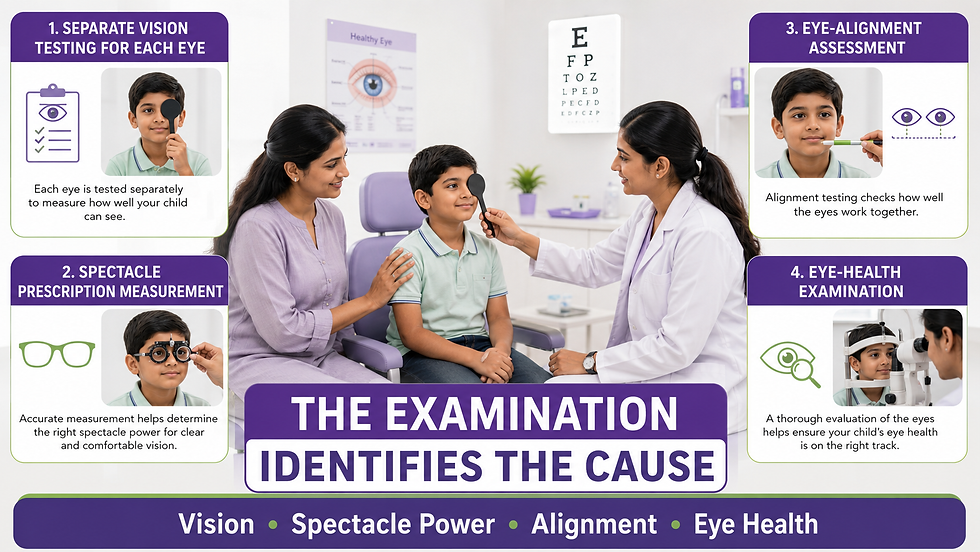
What Does a Child Eye Examination Check?
A detailed evaluation aims to identify why the child closes one eye rather than treating the behaviour itself.
The examination may include:
Vision measurement in each eye
Each eye must be tested separately. Testing with both eyes open can miss unilateral weaker vision because the better eye compensates.
Spectacle-power assessment
Refraction checks for short sight, long sight, astigmatism and unequal power. Dilating drops may be used because relaxing the focusing muscles helps measure a child’s prescription accurately.
Eye alignment
Cover tests and other alignment assessments check whether either eye turns and whether the deviation differs between near and distance viewing.
Eye movements
The examiner checks whether both eyes move fully and together in different directions.
Binocular vision
Where age and cooperation allow, tests may assess how the eyes work together and whether depth perception is present.
Eye-health examination
The cornea, pupil, lens, retina, optic nerve and other structures are evaluated to exclude conditions that may reduce vision or cause discomfort.
The page When Does a Child Need an Amblyopia Evaluation? explains the assessment pathway in more detail.
What Treatment May Be Recommended?
Treatment depends on the diagnosis. Closing one eye is a symptom or behaviour—not a condition that has one standard treatment.
Correctly prescribed glasses
Glasses may be recommended when blur, unequal prescription or accommodative eye crossing is present.
Consistent wear may improve visual clarity and, in selected children, eye alignment. Vision should then be rechecked to determine whether amblyopia remains.
Amblyopia treatment
If one eye has reduced visual development, treatment may include spectacle correction followed by patching or another clinically selected approach.
Parents should not patch the eye they see the child closing. The closed eye is not necessarily the weaker eye, and incorrect patching may create avoidable problems.
The parent guide Eye Patching for Lazy Eye explains why the eye and duration must be prescribed.
Squint management
Squint treatment depends on the type, frequency, cause, spectacle prescription and effect on vision.
Options may include:
Glasses
Monitoring
Amblyopia treatment
Prisms in selected situations
Exercises for specific binocular problems
Eye-muscle surgery where clinically indicated
Squint surgery adjusts alignment but does not automatically correct amblyopia.
Treatment of eye disease or irritation
A corneal injury, inflammation, cataract, eyelid condition or other eye-health problem requires treatment directed at the underlying cause.
Observation and follow-up
When the examination is reassuring and the behaviour is infrequent, observation may be appropriate. Parents may be advised to record changes and return if the pattern becomes more frequent or new symptoms appear.
When Should Parents Arrange an Eye Evaluation?
Arrange a routine child eye evaluation when:
The child repeatedly closes the same eye
The behaviour occurs during reading or television viewing
An eye occasionally turns or drifts
The child tilts or turns the head
Distance vision appears unclear
Reading causes headache or visual fatigue
The child reports blur or double vision
A school screening result is abnormal
The spectacle powers differ substantially
The behaviour is increasing in frequency
A screening can identify children who need further assessment, but it does not replace a comprehensive eye examination. The AAO advises ophthalmology assessment when screening suggests misaligned eyes, amblyopia or refractive error.
Which Signs Need Prompt Medical Attention?
Seek prompt medical assessment when eye closing is associated with:
A sudden or newly developed squint
Sudden double vision
Sudden reduction in vision
Severe headache or vomiting
Weakness, imbalance or altered behaviour
Drooping of one eyelid
Abnormal or restricted eye movement
Eye injury or chemical exposure
Significant pain, redness or swelling
A white pupil or unusual white reflection in photographs
A child who cannot comfortably open the eye
Symptoms following a head injury
Do not wait for a routine screening appointment when symptoms are sudden, painful or associated with neurological or systemic signs.
What Should Parents Avoid Doing?
Parents should not:
Start patching without an examination
Assume the eye being closed is the weaker eye
Buy glasses without a measured prescription
Diagnose lazy eye from a photograph alone
Ignore a newly developed eye turn
Use another child’s treatment schedule
Delay assessment because the child does not complain
Attribute persistent behaviour only to screen use
Ask the child to force both eyes open when this causes discomfort
The aim is not to stop the child from closing an eye through repeated reminders. The aim is to identify whether the child is compensating for an underlying visual problem.
Frequently Asked Questions
Why does my child close one eye while reading?
The child may be reducing blur, double vision or visual confusion caused by unequal spectacle power, eye misalignment or difficulty coordinating the eyes at near distance. The behaviour can also be habitual. A repeated pattern should be evaluated.
Why does my child close one eye while watching television?
Television viewing depends mainly on distance vision. Closing one eye may be associated with blurred distance vision, an intermittent eye turn or difficulty using both eyes together. Observe whether the child also sits close, turns the head or squints.
Does closing one eye mean that the child has lazy eye?
No. A child with amblyopia may close one eye, but the behaviour can also occur with squint, refractive error, double vision, glare or eye discomfort. Separate vision testing is needed.
Is the eye being closed always the weaker eye?
No. The child may close the weaker eye, the drifting eye, the better eye or either eye depending on lighting and the task. Parents should not determine treatment based on which eye appears closed.
Can an outward eye turn make a child close one eye?
Yes. Children with intermittent exotropia may close one eye, particularly in bright sunlight or when the outward turn appears. The eye deviation may be more noticeable when the child is tired or daydreaming.
Should I cover the eye that my child keeps closing?
No. Do not begin patching without a complete examination. The correct eye and treatment duration must be prescribed after measuring vision and identifying the cause.
Can too much screen time cause a child to close one eye?
Long periods of near work or screen viewing may contribute to visual fatigue, dryness or discomfort, but persistent closure of one eye should not automatically be attributed to screen time. An examination may be appropriate.
When is closing one eye urgent?
Prompt assessment is appropriate when the behaviour begins suddenly or occurs with double vision, sudden vision change, severe headache, vomiting, weakness, abnormal eye movement, drooping eyelid, injury, pain, swelling or a white pupil.


Comments